About the Event
When the Philippines joined the U.S.-led Pax Silica initiative in April 2026 and announced plans for a roughly 1,618-hectare “Economic Security Zone” in New Clark City, Tarlac, it placed itself at the center of one of the defining contests of the AI era: the race to secure the silicon supply chain that runs from critical minerals to advanced chips. National leaders have endorsed the hub as a driver of jobs, investment, and industrial upgrading. Others (civil society, indigenous peoples’ groups, faith-based and environmental advocates, and some legislators) have raised pressing questions about water and energy demand, watersheds and agricultural land, the situation of Aeta communities and farmers nearby, and what a “joint governance” arrangement means for national sovereignty. Much about the project remains unclear even as the framework agreement moves toward implementation.
Fair Transitions Lab, in collaboration with the Manila Observatory – Klima, invites you to a calm, fact-focused conversation that brings government, industry, academics, students, lawyers, environmental advocates, and community voices to the same table. Together they will clarify what Pax Silica is and where the New Clark City zone stands, map the risks and opportunities for each stakeholder, and ask what a fair, transparent, and sustainable model of participation could look like.
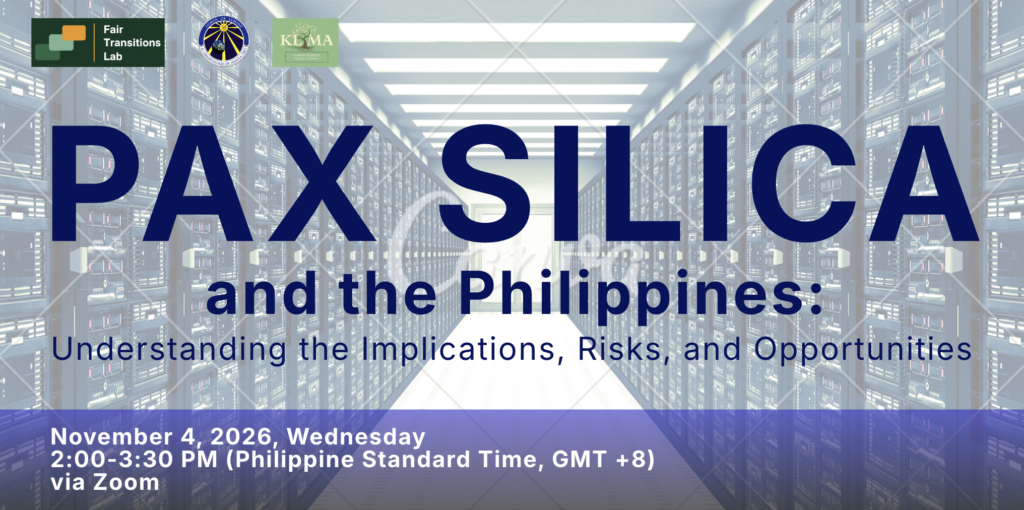
Date: November 4, 2026, Wednesday
Time: 2:00–3:30 PM (Philippine Standard Time, GMT+8)
Format: Online via Zoom
Panel Composition
| Speaker / sector | Focus in the dialogue |
| Baseline briefing on Pax Silica Ms. Florence Principe Gamboa Managing Editor and Coordinator FACTS Asia | Sets the baseline – what Pax Silica is, which countries are involved, and the nature, terms, and current status of the Philippines’ participation and the New Clark City zone. |
| Governance, policy & global politics Prof. Antonio Gabriel M. La Vina, JSD Head, Klima Center Manila Observatory | Addresses the political implications and the Philippines’ positionality within the U.S.–China technology competition, and the policy and governance frameworks that should guide participation. |
| Environmental & sustainability perspective Prof. Giovanni A. Tapang Dean, College of Science University of the Philippines | Risks on water security and watersheds, energy demand and grid impacts, land use, and need for environmental safeguards and compliance. |
| Community & indigenous peoples’ perspectives Atty. Raymond Marvic (Ice) C. Baguilat Program Head, Indigenous Peoples Law and Policy Program UP Institute of Human Rights | Rights, FPIC, livelihoods, benefit-sharing, and social impact for host and neighboring communities and indigenous peoples. |
| Moderators Atty. Railla Puno Executive Director Fair Transitions Lab Yla Gloria Marie Paras Deputy Director – KLIMA Policy Manila Observatory | Frames the discussion, keeps it balanced and fact-focused, and leads the fireside chat and the open forum. |
Indicative Program
| Time | Segment |
|---|---|
| 2:00–2:05 | Welcome, framing, and objectives (Moderator) |
| 2:05–2:15 | Baseline briefing on Pax Silica |
| 2:15–2:45 | Preliminary statements of the speakers |
| 2:45–3:15 | Fireside chat |
| 3:15–3:25 | Open forum |
| 3:25–3:30 | Synthesis and close |
Who May Attend
The dialogue is open to:
- Government officials from relevant Philippine agencies
- Policy and governance experts
- Local and international lawyers
- Academics, researchers, and undergraduate/postgraduate students
- Representatives from relevant industries (semiconductors, critical minerals, technology, energy)
- Indigenous peoples and community representatives
- Environmental advocates and civil-society organizations
- General public who may be interest in this topic
Registration
Interested participants may register via this form.
Inquiries
For questions, please email contact@fairtransitionslab.org.