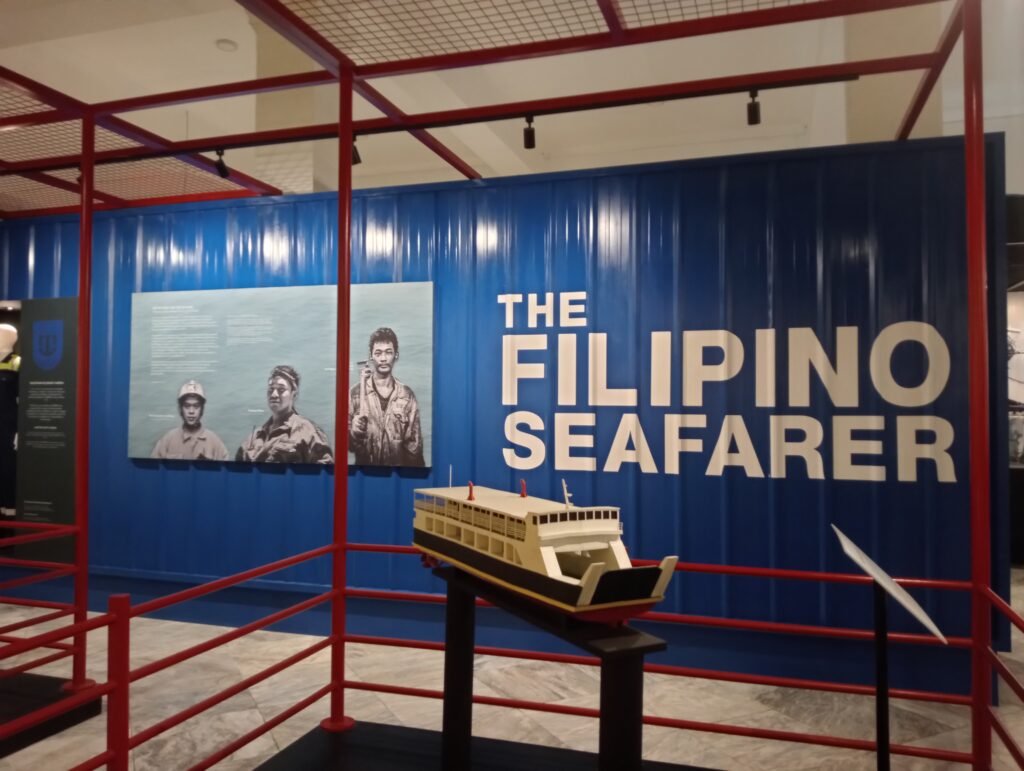
The global shipping industry is being asked to do something unprecedented yet long overdue: remove carbon from a sector that moves roughly 90% of world trade and still runs, overwhelmingly, on fossil fuel. The International Maritime Organization (IMO) has committed the sector to net-zero emissions by or around 2050, and the alternative fuels, engines, and rules that will get it there are already taking shape. But behind every vessel is a crew, and behind a striking share of the world’s crews stands a single nation. This raises a question easily lost amid the technical debates over ammonia, methanol, and carbon pricing: to what extent, and in what ways, will Filipino seafarers be affected as shipping decarbonizes? The answer matters not only for the roughly half a million Filipinos who go to sea, but for the country whose economy they help keep afloat.
The Backbone: Who Filipino Seafarers Are, and Why They Matter
The scale is difficult to overstate. In 2024, the Philippines deployed 504,057 seafarers to foreign-flagged vessels, about a fifth of all overseas Filipino workers sent abroad that year. By most reckonings the Philippines remains the largest single-country source of maritime labour in the world, whether measured by the traditional estimate of around a quarter of the global workforce or by figures putting the Filipino share at “32% of the global maritime workforce”. Either way, no other country supplies more.
Philippine deployment data sort Filipino seafarers into three broad groups: Officers (~20%), Ratings, or non-officer crew (~35%), and Non-marine crew (40%). This means that more than half of the Filipino maritime workforce are highly exposed to automation.
What ties these workers to the national interest is money sent home. Filipino seafarers remitted close to US$7 billion in 2024, nearly a fifth of the country’s total cash remittances of US$34.49 billion, a record equal to roughly 8.3% of GDP. A study by the University of Asia and the Pacific’s Center for Research and Communication, with the ALMA Maritime Group, found the industry generated ₱1.06 trillion in economic activity in 2024, about 4% of GDP. A peso sent home does not stop with the family that receives it: spent on housing, education, food, and local services, it generates close to three pesos of economic activity. Seafarers are, in a literal sense, part of the backbone of the Philippine economy, which is exactly why the coming transition is an equity issue.
Decarbonization, Net-Zero, and the Promise of a “Just Transition”
Shipping’s turn toward net-zero is now a matter of hard regulation, not aspiration. Under its 2023 GHG Strategy, the IMO set a course for net-zero emissions from international shipping by or around 2050, with an interim goal for zero- and near-zero-emission fuels to supply at least 5% of the sector’s energy by 2030. In April 2025, member states agreed in principle to the IMO Net-Zero Framework, a first-of-its-kind combination of a global fuel standard and a carbon-pricing mechanism for ships above 5,000 gross tonnage, which account for some 85% of shipping’s emissions. Its adoption has stalled however, with an extraordinary session in October 2025 adjourned amid political pressure. The April 2026 committee meeting also ended without adoption, deferring a decision to late 2026. The direction of travel, however, is set.
Decarbonization on this scale reshapes work. Moving from heavy fuel oil to ammonia, methanol, or hydrogen means new engines, new safety regimes, and new competencies. Research commissioned by the Maritime Just Transition Task Force, created at COP26 by the IMO, the ILO, and shipping and labour bodies—estimated that as many as 800,000 seafarers may need additional training by the mid-2030s to handle these fuels safely. That burden will not fall evenly: engineers and engine-room ratings, who must master the combustion, containment, and emergency handling of fuels far more hazardous than heavy fuel oil, sit at the front line, while deck officers face new bunkering and compliance duties. Already, seafarers are concerned about workload, stress, fatigue, and even fears of criminalization.
This is where just transition becomes an imperative. Born in the labour movement and now embedded in the Paris Agreement, the concept holds that the shift to a low-carbon economy must not be paid for with the livelihoods of workers in the industries being transformed and that those least responsible for emissions and least able to absorb the shock should not be left behind. In shipping, it means ensuring that seafarers are retrained, protected, and given a path into the new roles the transition creates, rather than stranded on obsolete tonnage or squeezed out entirely. The challenges are real. Alternative fuels carry genuine health and safety hazards, the retraining burden is enormous, and a fragmented patchwork of rules raises the risk of legal exposure and uneven protection, an emerging “energy justice” problem that recent scholarship has begun to map.
Decarbonization’s burdens and benefits will not land evenly, and the Filipino workforce sits on the wrong side of that asymmetry. Currently, access to alternative-fuel training and certification is concentrated in wealthier maritime economies. If this pattern holds, seafarers from labour-supplying developing countries risk being funneled toward a shrinking pool of conventional ships or displaced altogether. The country has felt the fragility of externally-set standards before: in 2023, the European Union came close to withdrawing recognition of Philippine seafarer certificates, a move that could have cost some 50,000 Filipinos their jobs almost overnight. A disorderly green transition threatens the same kind of shock in slower motion.
To its credit, the Philippines has not been passive. It enacted the Magna Carta of Filipino Seafarers (Republic Act No. 12021) in October 2024, building a legal scaffold for seafarers’ rights, training, and reintegration, and has established tripartite bodies to prepare its workforce for a maritime just transition. Yet significant gaps remain in access to technical knowledge, standardized training materials, capacity-building, and affordable financing, limiting the ability of developing countries to prepare their maritime sectors for decarbonization.
For most workers, job loss is a household tragedy; for Filipino seafarers, it is also a national-development risk. Because seafarer remittances feed billions of dollars into the economy each year and sustain an onshore ecosystem of training centres, manning agencies, and services, a wave of displacement would ripple through consumption, tax revenue, and foreign-exchange stability. The CRC–ALMA study put it bluntly: when shipowners lose confidence in a workforce, ships leave, and with them roughly 4% of national GDP.
There is a sharper policy edge here. The IMO Net-Zero Framework’s economic pillar is meant to fund an equitable transition, channeling projected revenues of US$10–15 billion a year toward climate-vulnerable states, but its equity lens is trained on Small Island Developing States and Least Developed Countries. The Philippines is neither. As a middle-income country that supplies more of the world’s seafarers than anyone else, it risks falling into a blind spot: bearing the largest concentrated labour-transition burden while sitting outside the categories the transition’s financing was designed to reach. Closing that gap, that is, ensuring that seafarer-supplying states are recognised as stakeholders in how transition finance is designed and disbursed, may be one of the most consequential and least-occupied fronts in the maritime just-transition debate.
Way Forward
Shipping’s decarbonization is, rightly, celebrated as a climate breakthrough. But whether it is also a just one will depend on choices being made right now about training, certification, and the design of a global fund. For the Philippines, this is not an abstract debate. It is a question of whether half a million seafarers, and the millions who depend on them, will be carried into the new era of shipping, or left in the wake of a fleet that has sailed on without them.
Photo credit: Creative Commons